
Leveraging breakthrough mitochondrial science
NRG Therapeutics is pioneering a new approach to neurodegenerative disease by targeting mitochondrial dysfunction — a core driver of neuronal damage and disease progression.
Mitochondrial dysfunction and role of the mPTP
In neurodegenerative disease, a key driver of mitochondrial dysfunction and its downstream effects of neuroinflammation and neuronal death is the opening of the mitochondrial permeability transition pore (mPTP) in response to sensitization or activation by pathogenic proteins such as mis-localized TDP-43 in ALS1 and oligomeric α-synuclein in Parkinson’s2.
mPTP opening is linked to the pathophysiology in neurodegenerative diseases
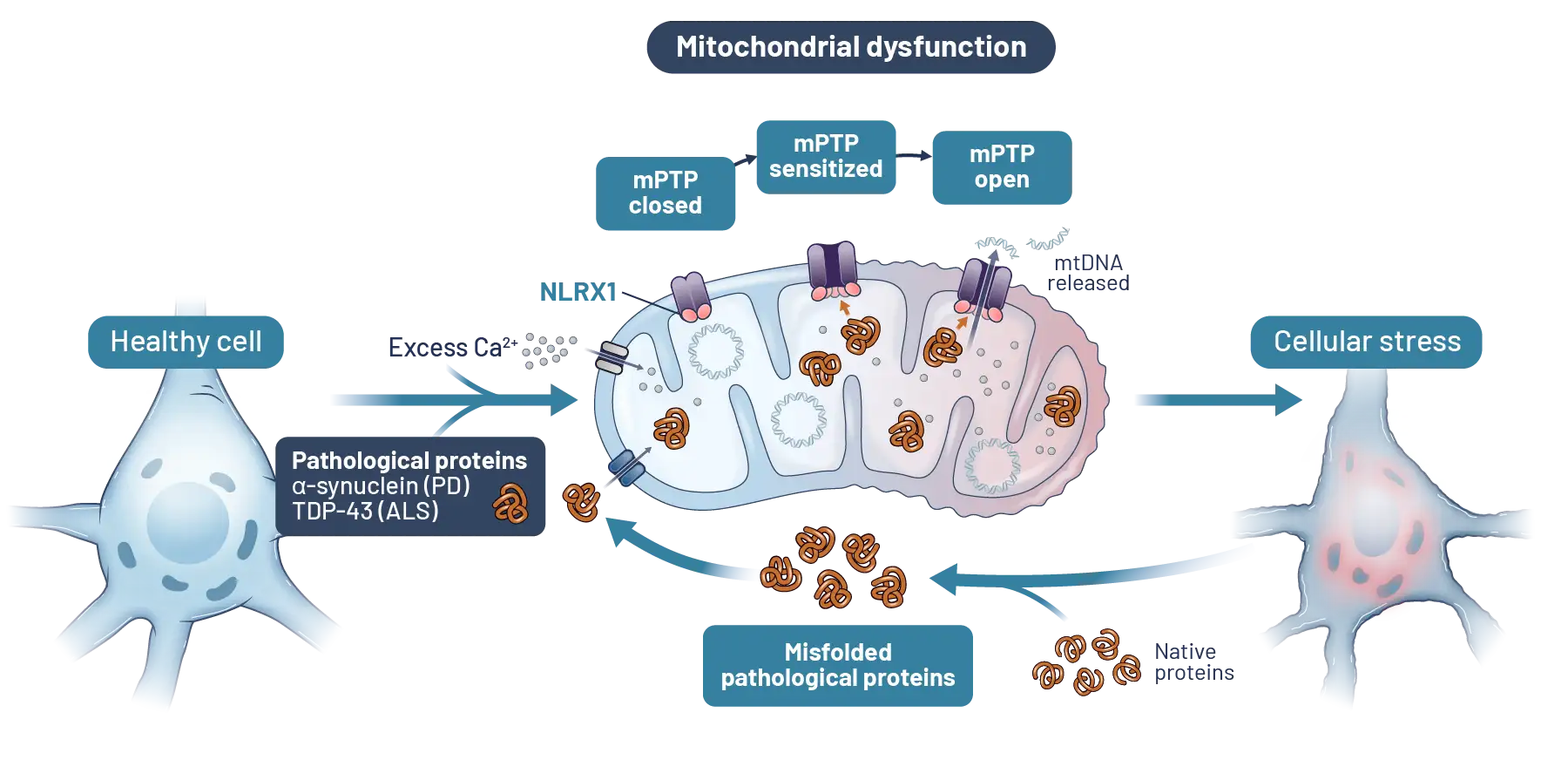
Mitochondrial dysfunction leads to oxidative stress, energy deficit and ultimately the death of critical neurons. The motor neurons in ALS and the substantia nigra pars compacta (SNc) neurons in Parkinson’s are particularly vulnerable given their very high energy demands.
The mPTP is a key driver of pathophysiology in ALS and Parkinson’s
ALS
Inhibition of the mPTP prevents the aberrant release of mitochondrial DNA, a pathogenic pathway recently discovered to activate the innate immune system in ALS. 1
Parkinson’s
Inhibition of the mPTP prevents the activation of mitochondrial mediated cell death by toxic forms of α-synuclein in Parkinson’s. 2
NRG5051 – lead clinical asset
Our lead asset is the small molecule drug NRG5051 which is progressing through Phase 1 clinical studies. NRG5051 is a potent inhibitor of the mPTP, acting via a novel NLRX1-mediated mechanism-of-action, that protects mitochondrial function and prevents neuronal death.
Our lead indication is ALS with a planned expansion into Parkinson’s and potentially additional neurodegenerative diseases.
References
- TDP-43 Triggers Mitochondrial DNA Release via mPTP to Activate cGAS/STING in ALS: Yu et al., 2020, Cell 183, 636–649
- α-synuclein oligomers interact with ATP synthase and open the permeability transition pore in Parkinson’s disease: Ludtmann et al., 2018, Nature Communications, 9, 1-16
- Phenotypic CRISPR screens identify NLRX1 as an essential activator of the human mitochondrial permeability transition: Valinsky et al., 2026, PNAS 123, 1-12
- The innate immune receptor NLRX1 is a novel required modulator for mPTP opening: implications for cardioprotection. Xiao et al., 2026 Basic Res Cardi 120, 707-725
© NRG Therapeutics


